VIENNAVARS

Visualization and Interpretation of the early medieval fEmale avar populatioN through archaeothaNAthology from Vienna/Austria (csokorgasse-buRialS)

Visualization and Interpretation of Female Lifeworlds in the Avar Period (7th–8th Centuries AD):
The Population of the Csokorgasse Cemetery, Vienna 11

Interdisciplinary bioarchaeological and archaeological research on Vienna's largest early medieval burial ground — combining human osteology and paleopathology, investigations of female funerary customs and material culture, and long-term digital archiving.

705 Excavated Graves
428 3 m Hexbins (651 Burials)
348 Adults (182 M · 166 F)
7th–8th c. Avar Period
// 01 · INTERACTIVE CEMETERY MAP

Spatial Distribution, Bioarchaeology & Chronology

Interactive geospatial plan of the Vienna 11 – Csokorgasse cemetery (3 m hexbins; primary excavation documentation: Stadtarchäologie Wien) linking spatial burial patterns with bioarchaeological sex estimations and chronological phases.

Subset:
Thematic View:
Isolate Phase:
Basemap:
Transp.: 70%
basemap.at Grau (70% transp.) · 428 Sectors (651 Burials) · Chronology View
SECTOR INSPECTOR

All Hexbins 428 Units ● Hover or click any hexbin or legend button to query

Cemetery-wide overview covering 651 burials across 428 3 m hexbins.

Total Burials
651
Dated Graves
575
Chronological Breakdown
● Early Avar (EAP): 213
● Middle Avar (MAP): 203
● Late Avar (LAP): 159
Undated Burials: 76
Primary excavation documentation: Wien Museum - Stadtarchäologie · 3 m hexbins.
// 02 · KEY FINDINGS & PUBLISHED FIGURES

Research Highlights & Evidence

Peer-reviewed bioarchaeological, paleopathological, and osteoarchaeological findings from the Vienna 11 – Csokorgasse research corpus — featuring three Open-Access project publications and their diagnostic figures.

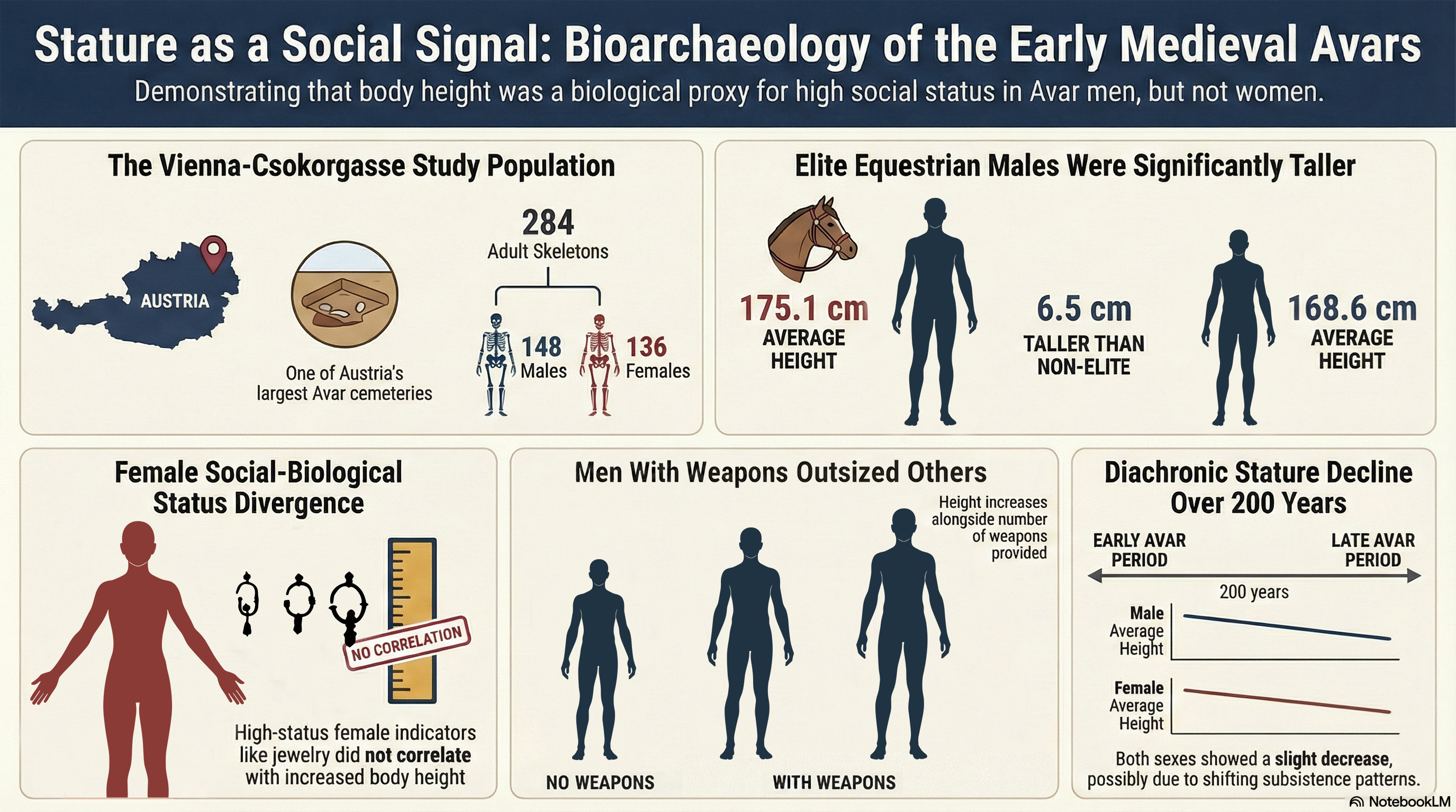
Kirchengast, Bühler & Hagmann (2026): Stature as a Social Signal among Early Medieval Avars
Bioarchaeology · Social Status
Open Access

Stature as a Social Signal & Female Lifeworlds

Bioarchaeological investigation of 284 undisturbed adult burials (148 males, 136 females; from 348 anthropologically documented adults) demonstrated a pronounced sex-specific pattern: high-status equestrian males averaged 175.1 cm (+6.5 cm over low-status males), whereas female body height did not vary across grave-good status tiers, pointing to distinct female social mobility and living conditions.

Kirchengast, Bühler & Hagmann (2026)
Nature & Anthropology 4 (1): 10004 (Graph. Abstr.)
DOI: 10.70322/natanthropol.2026.10004 ↗
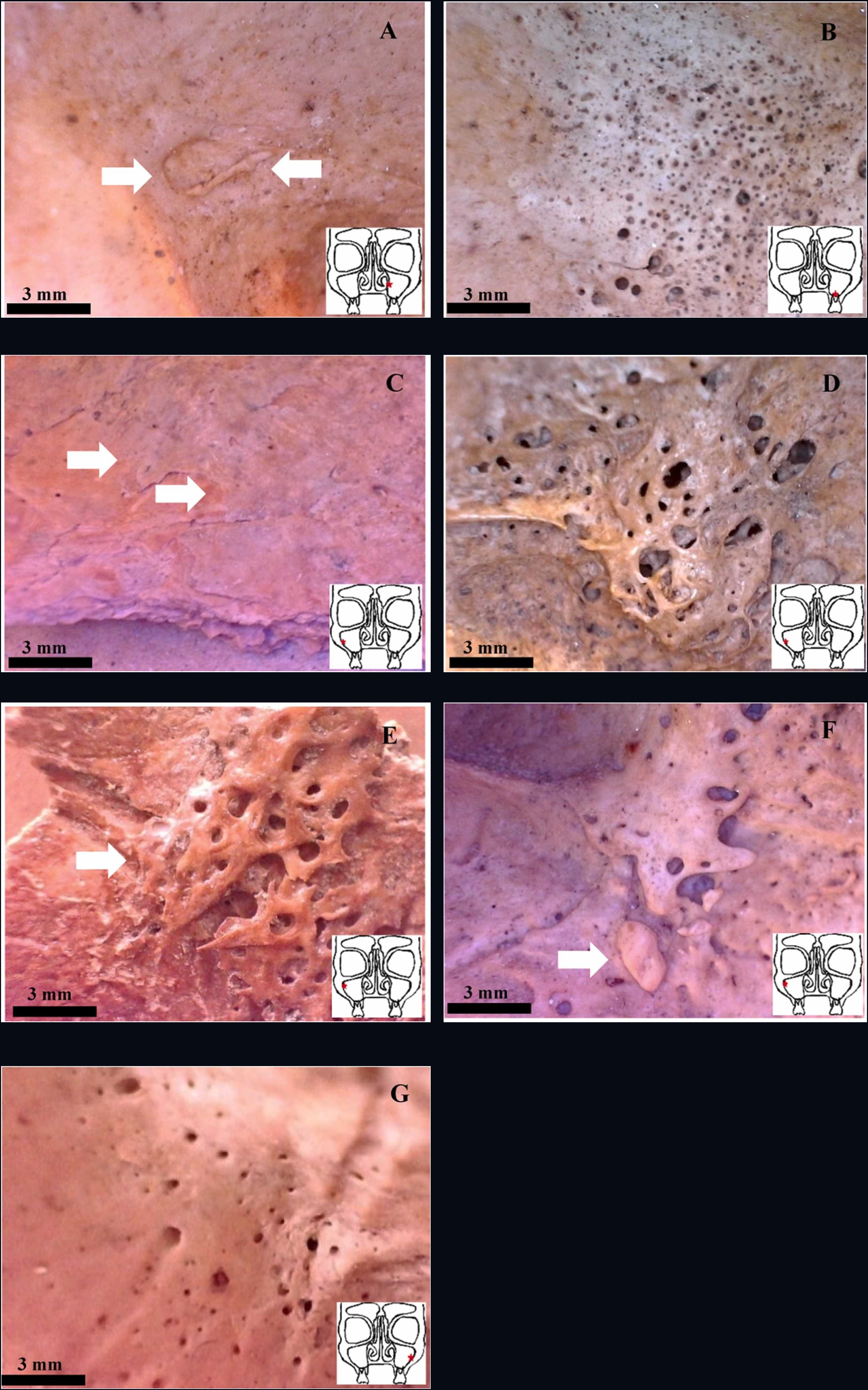
Becker & Kirchengast (2025, Fig. 5): Endoscopic and macroscopic bony changes in maxillary sinuses (pitting, white pitted bone, spicules, plaque)
Bioarchaeology · Paleopathology
Open Access

Sinus Bone Changes & Upper Respiratory Health

Comparative bioarchaeological and paleopathological study of 198 adult skeletons from the Csokorgasse cemetery using minimally invasive endoscopy. Bony changes in the maxillary and frontal sinuses — including pitting, white pitted bone, spicules, and plaque-like formations (Fig. 5, A–G) — reveal high rates of chronic upper respiratory tract stress linked to indoor smoke and living environments.

Becker & Kirchengast (2025)
Int. J. Paleopathology 49: 1–11 (Fig. 5)
DOI: 10.1016/j.ijpp.2025.02.004 ↗
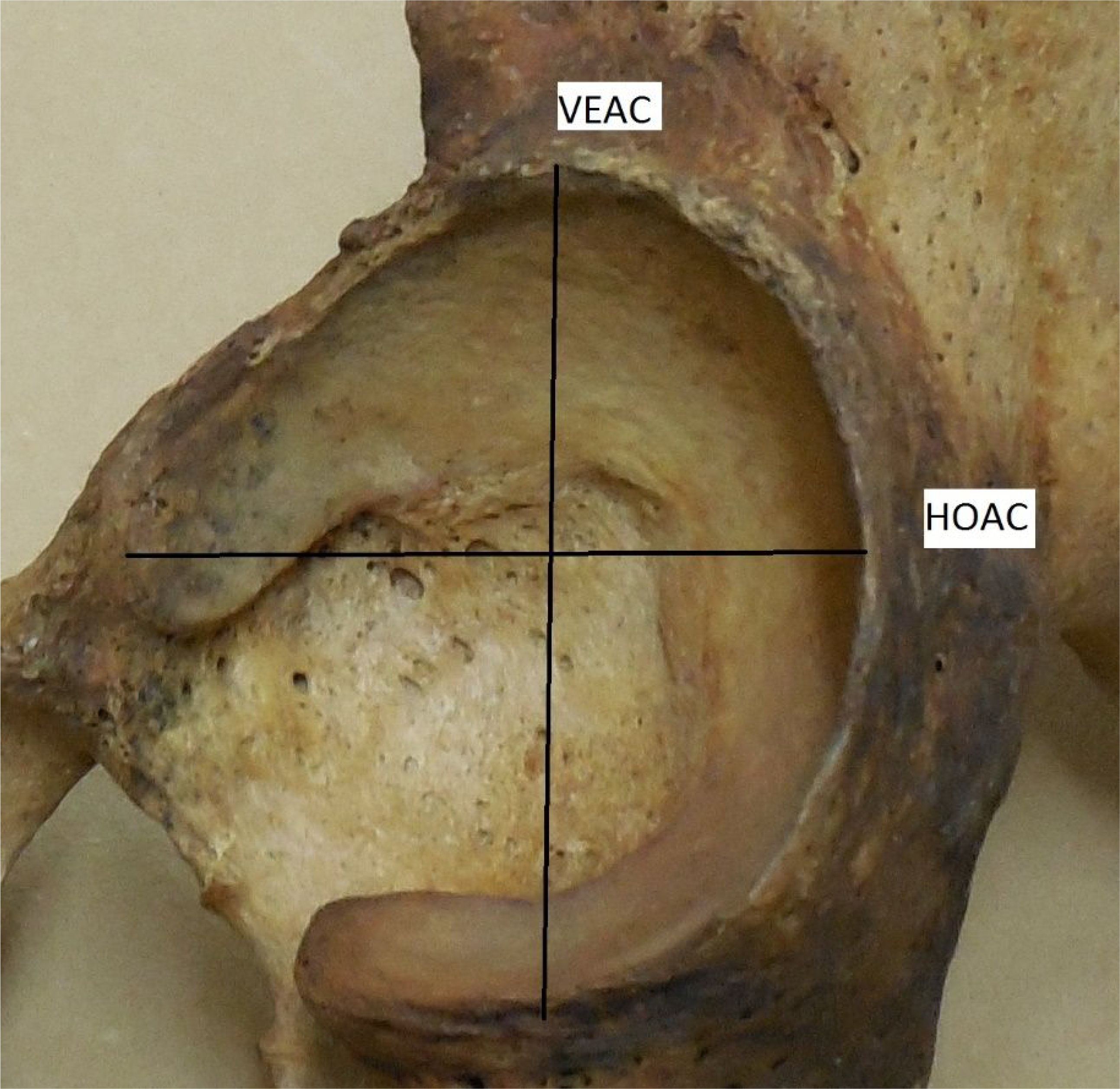
Bühler & Kirchengast (2022, Fig. 1): Measurements of the Index of Ovalization of the Acetabulum (VEAC and HOAC)
Bioarchaeology · Osteoarchaeology
Open Access

Habitual Horse-Riding: Sex & Chronological Shifts

Bioarchaeological and osteometric analysis of 149 adult skeletons (c. 625–800 AD) evaluating proximal femoral traits and the Index of Ovalization of the Acetabulum (VEAC/HOAC, Fig. 1). While males showed consistently high horse-riding indicators across all periods, females exhibited significantly higher acetabular ovalization in the earliest phases (c. 625–675 AD) followed by a marked chronological decline.

Bühler & Kirchengast (2022)
Int. J. Osteoarchaeology 32 (4): 821–831 (Fig. 1)
DOI: 10.1002/oa.3107 ↗
// 03 · RESEARCH LITERATURE

Publications & Articles

Peer-reviewed bioarchaeological, osteoarchaeological, paleopathological, and archaeological publications investigating the Vienna 11 – Csokorgasse cemetery. All registered DOIs and Open-Access articles are directly linked.

Showing 3 of 15 publications
// 04 · INSTITUTIONAL REPOSITORY

Long-Term Archiving & Data Governance

Permanent curation and indexing via the University of Vienna's institutional repository PHAIDRA.

Open Scientific Access · PHAIDRA o:2091644

VIENNAVARS Digital Research Collection

Open PHAIDRA Record (o:2091644) ↗

The digital research corpus of the VIENNAVARS project is permanently archived and indexed in PHAIDRA at the University of Vienna under persistent identifier o:2091644 and DataCite DOI 10.25365/phaidra.537. It encompasses bioarchaeological and anthropological analyses of the human skeletal remains, investigations of female funerary customs and material culture, and digital cartographic documentation.

// 05 · PROJECT INVESTIGATORS, INSTITUTIONS & FUNDING

Research Team & Institutional Framework

Interdisciplinary bioarchaeological and archaeological research project at the University of Vienna — uniting the Department of Evolutionary Anthropology, the Vienna Institute for Archaeological Science (VIAS), and the Research Network Human Evolution and Archaeological Sciences (HEAS) — funded by the City of Vienna (Hochschuljubiläumsstiftung der Stadt Wien, Grant H-448297/2023).

Dominik Hagmann portrait

Dominik Hagmann

Project Lead · Digital Archaeology
Department of Evolutionary Anthropology
& HEAS Research Network · University of Vienna
Sylvia Kirchengast portrait

Sylvia Kirchengast

Bioarchaeology & Evolutionary Anthropology
Department of Evolutionary Anthropology
& HEAS Research Network · University of Vienna
Birgit Bühler portrait

Birgit Bühler

Material Culture & Archaeometry
Vienna Institute for Archaeological Science (VIAS)
& HEAS Research Network · University of Vienna
// 06 · CITATION

Cite this Project & Dataset

viennavars_csokorgasse.bib — DOI 10.25365/phaidra.537
@dataset{viennavars_csokorgasse_2024,
  author    = {Hagmann, Dominik and B{\"u}hler, Birgit and Kirchengast, Sylvia},
  title     = {{VIENNAVARS: Visualisierung und Interpretation weiblicher Lebenswelten in der Awarenzeit (7. -- 8. Jhdt. n. Chr.) am Beispiel der Population des Gr{\"a}berfeldes Csokorgasse, Wien 11 / Visualization and Interpretation of the early medieval fEmale avar populatioN through archaeothaNAthology from Vienna/Austria (csokorgasse-buRialS)}},
  year      = {2024},
  publisher = {PHAIDRA -- University of Vienna},
  doi       = {10.25365/phaidra.537},
  url       = {https://phaidra.univie.ac.at/detail/o:2091644}
}